Most homeowners see a painting quote as a single number. Painters don't build it that way. Behind almost every professional estimate is the same basic formula: how many hours the job will take, what the materials will cost, a share of the cost of running the business, and a profit margin.
Knowing how those pieces fit together makes it much easier to understand why one quote is $3,800 and another is $6,200, and to ask better questions before you sign.
Step 1: Measuring the job
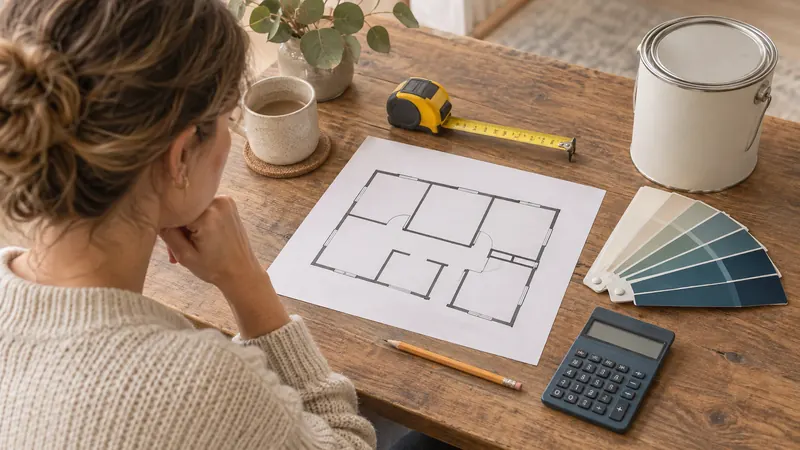
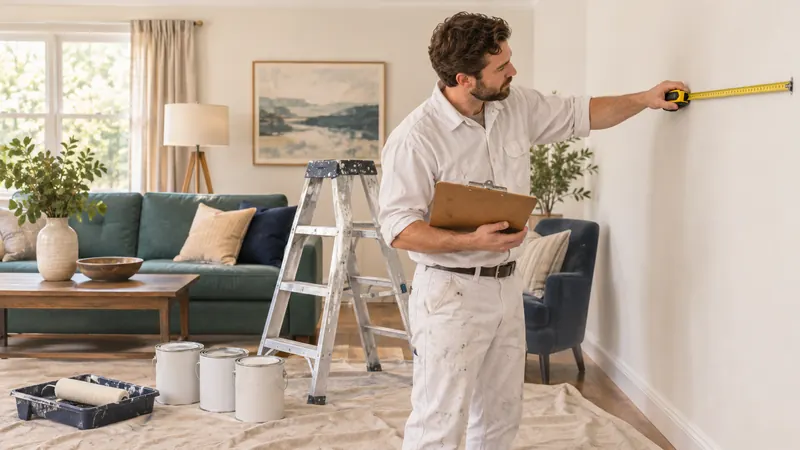
A painter starts by figuring out how much surface there is to paint and how hard it will be to paint it. For interiors, that usually means wall area (room perimeter times ceiling height, minus large openings), ceilings, and a count or linear-foot measure of trim, doors and windows. For exteriors, it means the square footage of siding plus trim, fascia, soffits, shutters and doors.
Measurements alone don't set the price. A painter is also sizing up the conditions that change how fast the work goes:
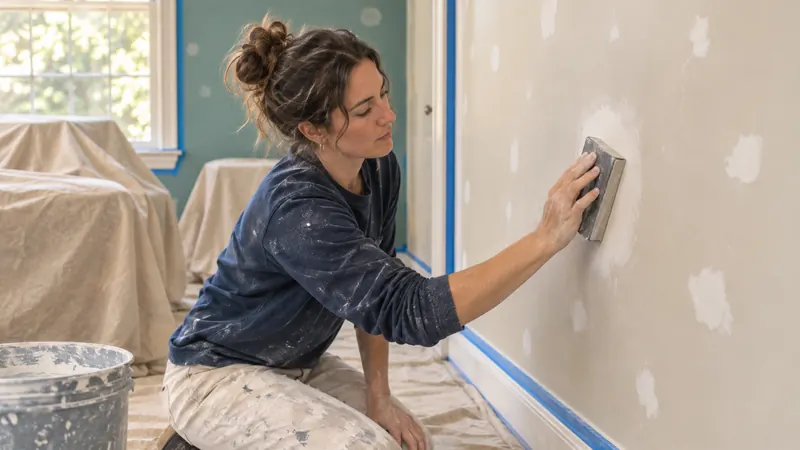
- Surface condition. Cracks, nail holes, peeling paint, water stains or bare wood all add prep time.
- Height and access. Tall ceilings, stairwells and second stories need taller ladders, planks or scaffolding.
- Detail. A room with lots of windows, built-ins or crown molding takes far longer than a plain box of the same size.
- Color change. Going from a dark color to a light one can mean primer plus extra coats.
- Occupancy. Furniture to move and cover, or a family living in the home, slows the crew down.
Step 2: Estimating labor hours
This is the heart of the quote. Painters estimate how many hours it will take to prep, prime, paint and clean up, then multiply by a loaded labor rate.
Labor dominates painting costs. Angi estimates that labor makes up 60% to 90% of the total cost of a painting project, and lists typical house painter rates of $20 to $50 per hour. That hourly figure is not what the painter takes home. The Bureau of Labor Statistics reports a median wage of $23.75 an hour for construction and maintenance painters as of May 2025. The difference between the wage and the rate on your quote covers payroll taxes, workers' compensation insurance, paid time between jobs, and the overhead described below.
Experienced estimators break labor down by task: so many hours to patch and sand, so many to cut in and roll each room, so many for trim and doors. Companies that do this carefully tend to produce quotes that hold up, without surprise charges halfway through the job.
Step 3: Pricing materials
Materials include paint and primer, plus caulk, patching compound, sandpaper, tape, plastic, drop cloths, roller covers and brushes.
Paint is the largest material cost, but it is smaller than most people think. Angi lists most paint at $20 to $70 per gallon, with budget products starting near $10 and designer brands topping $100. A gallon typically covers 300 to 400 square feet per coat. Even a large room with two coats might need only two or three gallons of wall paint.
Two things about materials are worth knowing:
- Contractors often pay less for paint than you would. Angi notes contractors can sometimes buy paint for around 50% less than retail through trade accounts.
- The paint line matters more than the brand. Most manufacturers sell several grades. A quote that names the specific product line tells you far more than one that just says "premium paint."
Step 4: Adding overhead
Overhead is everything it costs to keep a painting company running that isn't tied to one job: general liability insurance, workers' compensation, vehicles and fuel, equipment, office staff, software, licensing, and marketing.
These costs vary a lot from company to company. A small owner-operator with one truck has much lower overhead than a company with multiple crews, an office and a sales team. That difference shows up directly in the price, and it is one of the main reasons two honest contractors can quote the same job very differently.
Step 5: Adding profit
Profit is what lets a business stay open, replace equipment, handle warranty callbacks and survive slow seasons. A contractor who prices with no profit margin is either planning to make it up somewhere, such as cheaper paint, skipped prep or change orders, or isn't likely to be around if something goes wrong later.
Putting it together: a simple example
Here is a simplified, illustrative breakdown for repainting the walls and trim in a 14-by-16-foot living room with 8-foot ceilings, in good condition, same color family:
| Line | What it covers | Share of price |
|---|---|---|
| Labor | Moving and covering furniture, light patching, caulking, cutting in, two coats on walls, trim, cleanup | Largest share, often well over half |
| Materials | About 2 to 3 gallons of wall paint, 1 gallon of trim paint, caulk, patch, tape, plastic | Usually a modest share |
| Overhead | Insurance, vehicle, equipment, office, marketing | Varies widely by company |
| Profit | Return to the business | Varies by company and market |
Angi lists a typical cost of $450 to $1,350 to paint a 14-by-16-foot room, and the spread inside that range comes mostly from the labor and overhead lines, not the paint.
How painters present the number
Even though the math underneath is similar, painters present it in different ways:
- One lump-sum price for the whole scope.
- Per room or per area (for example, "living room, $1,050").
- Per square foot, usually as a way to explain the price rather than how it was built.
- Day rate or hourly, more common for small or hard-to-define jobs.
None of these is automatically better. What matters is that the written scope clearly lists the surfaces, the prep, the number of coats and the products, so you can compare one quote to another. Our guide to painting pricing methods explains each format in more detail.
What this means for you as a homeowner
When you understand how a quote is built, you can ask focused questions instead of just asking for a lower number:
- "How many coats are included on the walls and trim?"
- "What prep is included, and what would count as extra?"
- "Which exact paint product are you using?"
- "Is moving furniture included?"
- "Are you insured, and are your painters employees or subcontractors?"
If two quotes are far apart, the answers to those questions usually explain why. For a deeper look, see why painting estimates vary so much and our side-by-side quote comparison checklist.
Want to go deeper on the biggest ingredient? See why labor is 60% to 90% of your painting bill, and how floor area vs. wall area changes the math.
Frequently asked questions
What percentage of a painting quote is labor?
Labor is usually the largest part of the price. Angi estimates labor at 60% to 90% of the total cost of a painting project, depending on the job and the amount of prep involved.
Why is my painting quote so much more than the cost of paint?
Paint is a small part of the job. Most of what you pay for is skilled time spent preparing surfaces, cutting clean lines and applying multiple coats, plus the insurance, equipment and business costs that come with hiring a professional.
Do painters charge by the hour or by the job?
Most residential painters quote a fixed price for a defined scope, built from their estimate of hours and materials. Some charge hourly or by the day for small repairs or jobs that are hard to define in advance.
Sources
- Angi: How Much Does It Cost to Paint a Room? (updated October 2026)
- U.S. Bureau of Labor Statistics: Painters, Construction and Maintenance (May 2025 wage data)
Prices in this article are national ranges from the sources listed and are meant for planning. Your actual price depends on your home, your local market and the contractor you choose.