You've probably seen painting costs quoted as a number per square foot, like Angi's estimate of $2 to $6 per square foot for interior painting. The problem is that "square foot" can mean two very different things, and mixing them up can make a fair quote look expensive or a cheap one look reasonable.
Two ways to measure
Floor area
Floor area is the square footage of your home or room: length times width. It's the number on your listing or tax record. Some painters and many online estimates use it because homeowners already know it.
Wall area (paintable surface)
Wall area is the actual surface being painted. For a room, it's roughly the perimeter of the room times the ceiling height, minus large openings. It's a more accurate measure of the work, because painters paint walls, not floors.
How different the numbers can be
Take a simple 12 by 12 foot bedroom with 8-foot ceilings:
| Measurement | Calculation | Square feet |
|---|---|---|
| Floor area | 12 × 12 | 144 |
| Wall area | (12 + 12 + 12 + 12) × 8 | 384 |
| Wall area minus a door and window | 384 − about 35 | about 349 |
| Ceiling area | same as floor | 144 |
The wall area is more than double the floor area. So a painter charging $1.50 per square foot of wall area and another charging about $3.60 per square foot of floor area could be quoting nearly the same price for the walls of this room.
That's why a per-square-foot number without context is easy to misread.
Why ceiling height changes everything
Wall area grows with ceiling height, even when floor area doesn't. The same 12 by 12 room with 10-foot ceilings has 480 square feet of walls instead of 384, about 25% more surface. Taller walls also mean more ladder time. Angi notes that 10-foot ceilings can add about $1 per square foot to the cost. Our guide to high ceilings and stairwells covers this in more detail.
How to estimate your own wall area
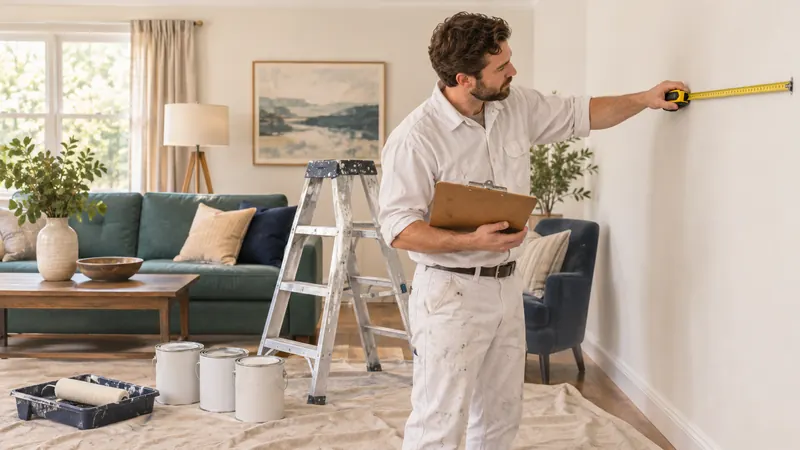
You can get a rough wall area for any rectangular room in a few steps:
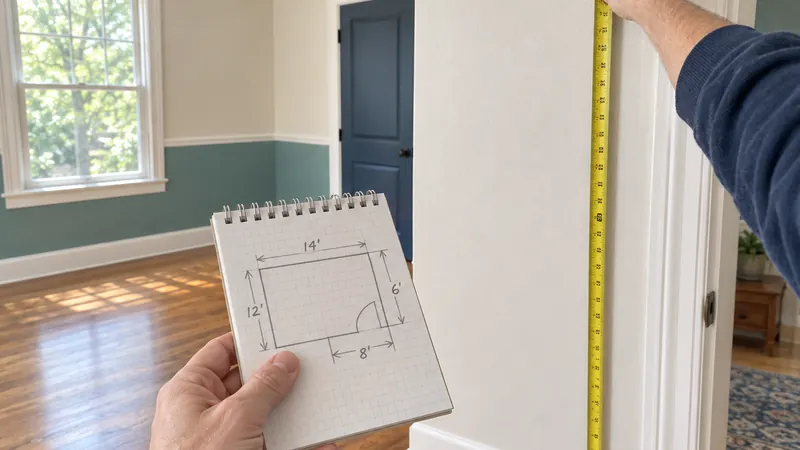
- Measure the length and width of the room.
- Add all four walls to get the perimeter. For a 12 by 14 room: 12 + 14 + 12 + 14 = 52 feet.
- Multiply by ceiling height. 52 × 8 = 416 square feet.
- Subtract big openings if you want more precision. A standard door is about 20 square feet and a typical window about 15.
Repeat for each room and add them up. For a whole-house estimate, it's common for total wall area to be several times the home's floor area, because interior walls are painted on both sides and each room has four walls.
Surfaces floor area doesn't capture
Even an accurate wall-area number leaves out a lot of the work:
- Ceilings, roughly equal to floor area
- Trim and baseboards, usually priced by the linear foot. Angi lists trim at about $1 to $3 per linear foot.
- Doors, often priced per door
- Closets, which have lots of edges for little area
- Stairwells and two-story foyers, which need extra equipment
Our guide to trim, doors and ceilings explains how much these can add.
What about exteriors?
Exterior pricing has the same issue. A quote might be based on the home's living area, on the measured siding surface, or on a flat price. Angi's exterior estimate of $1.50 to $4 per square foot is easiest to apply when you know which area the painter is measuring. Stories, gables and trim all change the real surface. See our comparison of one-story vs. two-story exteriors.
How to use this when comparing quotes
- Ask what the per-square-foot number is based on: floor area, wall area or something else.
- Compare total prices, not rates, once you've confirmed the scope is the same.
- Check which surfaces are included for that rate: walls only, or walls, ceilings and trim.
- Use online averages as a sanity check, not a target, unless you know how they were measured.
Our quote comparison checklist helps line up quotes that use different pricing methods.
Frequently asked questions
Do painters charge by floor square footage or wall square footage?
Both are common. Some painters use floor area as a shortcut for whole-house quotes, while others measure wall area for a more precise estimate. Ask which one a quote uses.
How many square feet of walls are in a typical room?
A 12 by 12 room with 8-foot ceilings has about 384 square feet of wall area before subtracting doors and windows. A 14 by 16 room has about 480.
Why does my quote seem higher than the per-square-foot averages online?
The average may use a different measurement than your quote, or it may cover walls only while your quote includes ceilings, trim and prep. Location also matters a lot.
Sources
- Angi: How Much Does It Cost to Paint a Room? (updated October 2026)
- Angi: How Much Does It Cost to Paint a House Exterior?
Prices in this article are national ranges from the sources listed and are meant for planning. Your actual price depends on your home, your local market and the contractor you choose.